Friday, June 29, 2007

United Nations World Food Program - Feeding the Hungry in Madagascar

I have just a few minutes, before the UN World Food Program (WFP) truck is coming to pick me up and bring me to their field site...

I spent the morning at WFP Madagascar country HQ, speaking with the Country Director, Deputy Country Director, Public Information Officer and Program Manager, learning more about their programs, successes, failures and challenges of working in this country.

Where do I begin? Mada is one of the most natural-disaster-prone areas of the world, and has suffered from seven debilitating cyclones in just the last six months alone, wiping out coastlines, crops, infrastructure, and villages, leaving entire communities displaced and in need. Most of these communities are tribal, and very disconnected from anything having to do with the hustle and bustle of Tana. Unfortunately, Mada's history has reflected much of the same, with 40+ cyclones, typhoons, etc. in the last few decades - and climatological research seems to indicate that these natural disasters are only on the increase.

So, much of WFP's work focuses on EMOPs (emergency operations), coming in to simply stabilize and support the immediate needs of the people. They work primarily in the south and southeast, but fly all over island, here and there, whenever a disaster strikes, prepositioning food in secure warehouses, which allows for quick and easy distribution when needed. Shockingly, the Mada government seems to have no emergency disaster plan whatsoever, so the most vulnerable people are left to depend on international organizations, who basically run around, putting out fires. With the sheer volume of disasters, I don't know how they have the resources or capacity to get ahead of anything, and focus on other development issues. But they do...

WFP also administers several school feeding operations, providing meals to students in 200+ schools around the country. This is often the only meal that these kids are getting in a day, which serves as an incentive for parents to send their children to school. These programs are supported by capacity building in the local communities, to develop more aggressive and successful agricultural practices, infrastructure building, etc. so the communities will eventually be able to take over their own programs independently (assuming they aren't wiped out by a cyclone)...

And next, Food for Work programs, where families contribute one family member to help on development and infrastructure programs (building roads , terracing farmland for cultivation, etc.), and receive rations large enough to feed their entire family.

This afternoon they are bringing me to a public health clinic in one of the poorest slums of Tana, working with AIDS and TB patients. WFP runs this clinic in cooperation with the World Health Organization, and UN-AIDS. WFP's primary function in this clinic is to provide adequate nutrition to patients taking anti-retrovirals and other strong, lifesaving medications. Remember, our meds indicate "take with food or milk" and even if we don't, it's safe to assume that we've eaten in the last 12 hours. So many of people simply don't have enough to eat, and are suffering from such acute malnutrition, that when they take these medications, their bodies can't metabolize them properly and the meds literally kill them. A lot of WFP's work in sub-Saharan Africa and other areas ravaged by the AIDS pandemic, focuses on the role of nutrition in the treatement of HIV/AIDS.

Ah, I love a relaxing vacation.
More later, when I return from the clinic...

Thursday, June 28, 2007

Antananarivo, Madagascar

Greetings from Madagascar. I'm at a clunky, old computer, which, for some reason will not allow me to post photos, so I'll have to ask you to use your imagination...

We flew through Johannesburg, where, for the first time in 16 years, it snowed. It was shocking to wake up and see a thin veil of white powder covering everything in sight...

From Joburg, we flew into Antananarivo, the capital of Madagascar. We're staying with my friend Luc while we're here, and his driver, Jean-Baptiste, came to the airport to gather us and our luggage.

Madagascar is a surprising country, in so many ways. First, the people here don't consider themselves part of Africa, or African in any way - and seeing this place, it makes perfect sense. It's an island nation, with its own culture, traditions and ancestry, which is very disconnected to the continent just to the west. So much of Madagascar is simply Malagasy - the closest comparison would be to Indonesia, both literally and figuratively. The Malagasy people are direct descendants from Indonesia and Malaysia, and look so, though their skin is much darker. The city of Antananarivo (called "Tana") is among the least developed I've ever seen. It looks like a Crusader village from the middle ages, with handfuls of living quarters slapped on the sides here and there, as families grow, business expands, creating a patchwork of ramshackle huts, stone quarters and shacks sliding up and down the hills that make this colorful, loud, packed city.

Most of the streets are dirt, and most of the people are barefoot, wearing tattered clothes, carrying baskets of live chickens, or piles of food on their head. Families here live on less than a dollar a day.

The people speak French, and I must say, they speak French beautifully - with a perfect Parisian accent.

Luc has a very special and unusual position here, working on a team of three people, serving as the leadership advisors to the President of Madagascar. The other two are Australian (one being Dean Williams, my professor from graduate school), and all are fervently, delicately and passionately working day and night to help this eager President increase the leadership capacity of his country, which is just starting to tiptoe its way toward the global arena. Not only do they work directly with the President, but also with the full administration, including an upcoming training for 17,500 village chiefs from all around the island.

He is also in an interesting position, which requires acute diplomacy, as he is a frenchman, working in a country colonialized by France. He equates his position to an Israeli consulting to the leaders of Palestine in 20 years.

Last night he took us into the grounds of the Presidential Palace, where we stepped over sleeping guards, so he could show us his office...

Luc is renting a house (if you can call it that - it's more of a villa) from a Kenyan woman who works for UNICEF, who is at home in Nairobi. He has two full-time guards, a driver and a maid, who maintain the house and property. These are very common conditions for an expat working for the UN or similar organization, as they are paid their national salary, which obviously, goes a very long way here. Female workers are required to have three guards, whereas men are required to have only two.

The homes here, as in South Africa, have no central heat, so they are warmed by wood-burning fireplaces - a welcomed amenity, as the winter (as it is now) is cool and misty. The smell is so inviting - it reminds of me of my childhood.

Last night, Luc drove us through the winding backalley-streets of Tana, to his favorite restaurant, where we sat among expat development workers, eating foie gras, french bread, and zebu (buffalo meat), washing it all down with red wine and coffee.

The contrast, obviously, between the lives of the local people and the expats working here, is quite dramatic. I felt much more uncomfortable with this contrast, and the luxuries afforded by international workers, when I was working in Aceh and Jakarta, Indonesia in 2005 during the tsunami reconstruction. This was my first experience in international development, and I wasn't prepared for the discrepancy between expat and local. I don't know what to think, and I don't know what to say about it, except that the work is hard, the conditions are rough, and perhaps a glass of wine and a hot shower rejuvenates one for the next day (the counter-arguments are aplenty, I know that... so I will just leave it at that).

Today, we wandered through the city streets, through alleyways, up stairs, down hills, rounding steep corners where we would find crowds of children, or old men playing board games, or an old, decrepit palace, falling into ruin. Maps are useless, streets are unmarked, which just leaves you with your feet and a sense of adventure.

Tomorrow I'm spending the day with the Country Office of the UN World Food Program, where I will meet with the Country Director and Assistant Country Director, learn about their programs in Madagascar and visit a school-feeding operation in Tana. I've brought briefing materials from my office in Washington DC, which I will read as homework tonight, preparing me for the day tomorrow.

And fortunately, we have convinced Luc to come to coast of Madagascar this weekend, where we will visit the Parc National d'Andasibe-Mantadia, and see the indigenous marvels of this country - the indiri (the largest lemur found in Madagascar, described as looking like a four-year old child in a panda suit), the giant jumping rat, and thousands of birds and plants, which are found only on this island.

I love this country so far. I'm intrigued, curious, and eager to see what the next few days hold for us...

Monday, June 25, 2007

Bumbling Along in Blaauwklippen

This day has lasted 42 hours... or at least so it seems!

After an evening of homemade soup, apple crumble and hours of sifting through Hilda's old photo albums documenting my friend Cath's radiant adolescence (oh, the haircuts!) in Johannesburg and Simon's Town, we bid the lovely seaside village adieu, and headed north along the coast with one goal in mind: Wine Country.

Driving along the coast was a magnificent ride, though admittedly, I seem to be battling a low grade, constant queasiness, as a passenger-on-the-left, feeling as though we are about to crash into light poles and sideswipe buses. Somehow, I don't think I've ever been in a car where people drive on the other side of the road.

Again, the weather. One moment it's sunny and gorgeous, with light streaming over the sea, turning the water brilliant shades of azure and emerald. The next, violent gangs of clouds come roaring over the peaks hugging the shore, and there is torrential downpour with winds threatening to flick our tin-can-car into the ocean. These rains are the kind of rains where you just don't even bother trying to keep dry - there's simply no point.

And onward we drove, along the coast, and then inland, up the hills to Stellenbosch, regarded as one of the great wine regions of South Africa, home to hundreds upon hundreds of wineries.

I'd like to start with a story. My friend Dimitri lives on the north shore of Long Island, also home to many vineyards... One weekend, Dimitri deposited me into his car, and took me wine tasting along the North Fork. He explained his theory to me: "After the first vineyard and first round of tastings, you say 'Ah, this is good.' After the second, you exclaim 'This is wonderful wine!' And after the third vineyard and round of tasting, which invariably is the best so far, you cheerfully embrace the sommelier who is so friendly, and end up buying a bottle of wine, or two, or three..."

So far, I've proven Dimitri theory to be true twice; once on the North Fork, and again today in Stellenbosch. We started off at Blaauwklippen, a gorgeous old estate dating back to the 17th century. We started off with a delicious lunch - I skipped the salad, and immediately ordered the ostrich (no offense to the lovely bird I saw roaming around the Cape of Good Hope yesterday!), paired with a wonderful house red. From there, we tore ourselves away from the braai (fireplace) and dashed across the grounds, through wind and sleet, into the tasting room, where we chatted with Wayne, the sommelier, for a quite some time. He liked us, so he discarded the standard tasting menu, and shared his personal recommendations with us - for over an hour. About 6 or 7 tastings later, we wound our way through the countryside, up and down hills (or at least it felt that way) to this vineyard, and that vineyard, singing songs, speaking in South African accents (or our bastardized versions, that is), laughing so hard our sides were splitting (this was all in the privacy of our car - we tried hard not to sully the stellar reputation of the American traveler!), finally ending up at the Spiers (again, Cath, thanks for the recommendation), and Saxenburg Wineries, where we drank a Cab and Shiraz, both of which won "Best in Country" awards in 2003. Good stuff.

And don't worry, Jane was the designated driver. And I was the designated chatter.

We both did very well in our respective responsibilities.

At the end of the day, we tumbled into our lawnmower-car, and sped along country and mountain roads, meandering our way back to Cape Town.

We passed a township along the way, which served as a startling and sobering (literally) reminder of the stark contrast and division in this country. Tin shacks, with plastic sheeting for walls, packed next to each other, as if they were bodies huddling together to keep warm, for as far as the eye could see. How do you reconcile this kind of poverty? How can you not want to work on economic development, ensuring opportunity and education and access, making good on the promises that were made fourteen years ago? How do you not get overwhelmed or heavy-hearted with the injustice? Sorry. This kind of thinking usually stays inside of my head (is anyone reading this anyhow?).

And now I'm back in Cape Town, my belly full of spaghetti and meatballs (the dish I seem to crave whenever I travel - and I still say the best exists in Guatemala). Tomorrow we'll try to get to Robben's Island, where Mandela was imprisoned for 27 years - the winds have made the sea so choppy that the boats were canceled today. Tomorrow night we leave for Johannesburg, where we'll connect to a flight to Madagascar, and see my friend Luc!

A word about security in Capetown. In addition to the weather, people seem to spend a lot of time here talking about crime. Homes, offices and private buildings are heavily walled, with razor wire and security guards. We're constantly being reminded to lock our car doors, and keep our bags on the floor to avoid "smash and grabs" which seem pervasive. Hilda told us of a neighbor who was stabbed to death in her home, by burglars looking for some loot. And never, ever, are we to walk outside at night. Normally, I'm used to these warnings, which I heed, albeit with some cynicism - simply read a tourism book advising travelers in NYC and you'll understand the hype and fear - but these advisories have a sense of urgency and gravitas, that, even though I don't *see* this possibility lurking around the corner, I definitely feel it.

The only other place I've felt that, is living in El Salvador, truly fearful of the gangs who had been deported from the USA for their growing criminal records, and sent back home, where they would terrorize their neighbors - having been slightly Americanized, and no longer totally Salvadoreno, they would create pockets of members, taking over who sections of El Salvador.

Questions answered: Yes, you can drink the water here. People speak English, though you hear Afrikaans, and dozens of other African languages all around you. The people here among the friendliest I've ever met. And everything is less expensive, though not completely cheap.

And now, sleep. Strangely, I haven't had a drop of jetlag!

I hope you're well!

Sunday, June 24, 2007

From Cape Town, to the Cape of Good Hope...

Greetings from Simons Town, South Africa. I’m about 45 minutes south of Cape Town, at the beginning of the cape, which eventually meets at the point of the Cape of Good Hope, the southernmost tip of Africa.

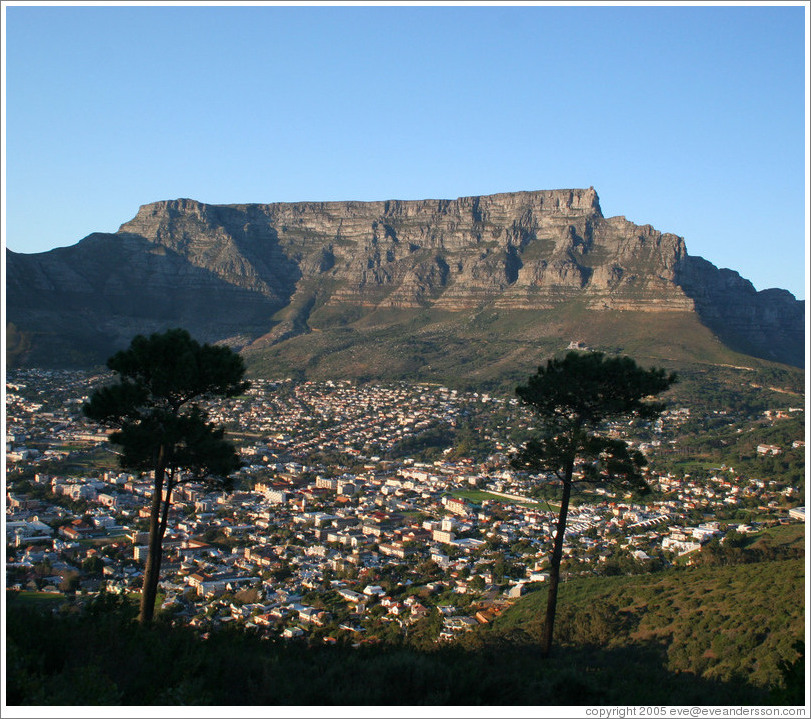
I arrived in Cape Town, a green, sophisticated and beautiful city on the western coast of South Africa, filled with colonial, Dutch architecture. Table Mountain, a huge, flat mountain, looms behind the city, grabbing the clouds as they drift by.

It’s winter here, and the people are dressed in layers of sweaters, scarves, and hats, and the weather is a constant topic of conversation. Folks are apologizing left and right for cold temperatures, asking us to return in the summer, when it is truly pleasant and welcoming.

It’s 60 degrees, and I’m wearing a t-shirt. I’m thrilled to be away from the DC summer.

Yesterday we found our way to the base of Table Mountain, where we were expecting to take a cable car to the top, promising magnificent views of the city and ocean below. Unfortunately, the winds were whipping, causing the cable cars to shut down – which seems to happen quite frequently. So, Jane and I walked down the road, seeking a trailhead, which we found about a kilometer down the road. We turned in, and started up the path. At first it was a walk, then a hike, and then an outright climb, passing waterfalls, cliffs and overhangs. We were about halfway up the mountain, when hikers starting climbing down, warning of the approaching “tablecloth” – storm clouds rolling in, promising extreme weather. We climbed up a little further, and found a trail cutting across the mountain for about 2 kilometers, eventually bringing us back down where we started. We touched back down, and the skies opened. Perfect timing.

From there, we took a cab back downtown. In chatting up the driver, we learned that he was from Rwanda. I wanted to know about him, but wanted to be respectful of what would be, undoubtedly, a sad story. He opened up after learning that I work for the World Food Program, telling us of fleeing his country, losing his family, living in a refugee camp in the Democratic Republic of Congo for over a year, and then finally moving to South Africa six years ago, where, miraculously, he was reunited with his wife and daughter. For more than a year, all of his meals came from WFP. This made up for every bad day I’ve ever had…

Last night we rented a car and drove south to Simons Town, where we are staying with Hilda Barry – a close family friend of Cath Byrne, from California, via Johannesburg (Hi Cath! We’re having a great time with Hilda! Thanks for putting us in touch!).

Today we drove… first to Boulder Beach, home to thousands and thousands of African, or “jackass,” penguins. They roam along the beaches, burrowing holes in the sand where they lay eggs, and warm their newly hatched babies. They’re smaller than I expected, about 2-1/2 feet tall, and the male penguins “bray” (hence the name “jackass”) to defend their nests. At one point, we came to a clearing, where there thousands of penguins gathered on the shore, lobbing from side to side, and diving into the water.

The rest of our day was spent driving south, to the Cape of Good Hope – the southernmost tip of Africa. All I can say is that this area is a land of big weather. Big clouds, big winds, big bursts of torrential downpours, big sunrays streaming through big cracks in the sky, and big rainbows, stretching out from the peaks of big, craggy mountains tumbling into the sea.

We encountered ostriches along the road; graceful reminders of our location. Arriving at the Cape of Good Hope was difficult for my mind to digest. A man chased baboons away with a stick, as we started our way up the hill, to a lighthouse that stood at the end point where the Indian and Atlantic oceans meet. The wind was whipping and lashing, tearing away anything that wasn’t connected to my body. It was a moment to just stop and be still. Sometimes I worry that I can’t be impressed anymore – and I’m always so happy to prove myself wrong.

I’ve received a few emails with questions about post-apartheid Africa. I’m intrigued, and (I know you’ll find this surprising) am asking questions along the way – but I’m not qualified to talk about race, history and South Africa. Cape Town is a very white city, and the thoughts and opinions I’ve gathered have been from white South Africans. It has been 14 years since the end of apartheid, and in many ways it's been *only* 14 years since the end of apartheird. I expect that I will have something to say toward the end of this trip. People seem not to speak too deeply about race, yet there is a quiet “something” that is acknowledged – a tension. The radio plays tributes to Steven Biko, offering reminders to relieve yourself of the burdens of inferiority and oppression.

Tomorrow we head east of Cape Town to some of the vineyards. This should prove interesting; wine tasting, while driving on the wrong side of the road...

I hope you’re well!


Wednesday, June 20, 2007

Pre-Trip Flurry...


"There is no moment of delight in any pilgrimage like the beginning of it."

-- Charles Dudley Warner


I always get nervous before I leave for a faraway trip. The idea of being so disconnected (though, of course, I'm really not) and inaccessible (though, of course, I'm really not) sends little pings of anxiety through my nerves. But these pings eventually join together, like freckles merging on my arm, filling me with such excitement and passion, which I've found only rarely in other areas of my life.

I arrive wherever I'm going, and I rediscover the beauty of everyday life somewhere else, with my senses heightened, absorbing everything around me like a sponge. And so much is the same - eating, drinking, laughter, work, walking, talking, learning how to approach the speed-bumps or just make do, but surrounded by different colors, spices, smells, flavors, music, language, landscapes. I get hungry just thinking about it.


The familiar pre-trip flurry has set in, of throwing things in a bag, fishing for my passport and trying to decide which books to bring. So many friends have sent me contacts for here and there, that I'll probably never be alone; having meals with new friends, sipping tea on a balcony in Simon's Town with friends' fictive kin, meeting new children for the first time, and being invited to step into strangers' everyday lives.


How did I stumble into this amazing pastime?

Wednesday, June 13, 2007

South Africa Shutdown as Strike Intensifies

Horacio just sent me this article from Yahoo! news. Hmmmm. I wonder how I'll run into this while I'm in South Africa....

by Isaac MangenaWed Jun 13, 5:37 PM ET

The biggest strike in South Africa since the end of apartheid intensified Wednesday as hundreds of thousands more workers downed tools, bringing large parts of the country to a standstill.

Bus and train services, refuse collections and court sittings all ground to a halt as the unions staged a massive show of strength with marches through the centre of the country's main cities.

Despite optimism from President Thabo Mbeki the wage dispute could soon be resolved, the effect further paralysed a country where most public schools have been closed since the start of the month and hospitals are only able to operate a skeleton service with army medics.

As newspaper headlines proclaimed "Shutdown" "Brace Yourself, SA", the Congress of South African Trade Unions (COSATU) vowed to force the government into raising their pay offer from the current 7.25 percent. Unions are holding out for 10 percent.

COSATU spokesman Patrick Craven said there was "considerable disruption" as protesters took part in 46 marches organised across the country.

"There is not a shadow of a doubt that hundreds of thousands joined the strike one way or another," he told AFP.

"There has been considerable disruption in the government's public services. Schools were not operating, health institutions ran a little service, and buses and taxis ... were not functioning. It was major and we hope this will convince government to listen to our demands," he added.

The impact of the strike was felt by commuters, with few trains operating and many bus drivers joining the stoppage, including from private firms.

Government offices also reported major disruption to services.

Tens of thousands of union members who chose to stay away from their workplace took to the streets in cities such as Johannesburg, Pretoria and Cape Town to demand an increase in pay and better conditions.

Papa Dlamini, a male nurse at Carltonville hospital west of Johannesburg, acknowledged the strike had caused much suffering but defended the stayaway.

"It hurts us that our people are dying but the situation does not allow us to go to work," he told AFP at a march in downtown Johannesburg attended by several thousand marchers.

"We blame the government for not giving us what we want, for the death of our patients and also for our children not being in school."

Thulas Nxesi, secretary general of the South Africa Democratic Teachers Union, gave little hope the dispute would end any time soon.

"We regret to inform you that what is supposed to be negotiation has so far become a joke. Instead the employer, which is our government, did not show any political will and commitment to deal with issues on table," he told the rally.

After being handed a list of the workers' demands, the premier of Gauteng province, which includes Johannesburg and Pretoria said it was in everyone's interest that a solution be found when negotiations resume on Friday.

"We are aware the negotiations have been going for far too long, that it is important that all of us ... put our heads together to find an acceptable settlement in the best interests of both workers and government," Mbhazima Shilowa said.

Church groups also added to the pressure on the government to reach a settlement, with the Southern African Catholics Bishops' Conference calling on it to "treat public servants with the dignity and respect they deserve."

In a speech before parliament on Tuesday, Mbeki expressed confidence the dispute could soon be resolved.

"I would like to reiterate our confidence that in time, government as employer and the public service unions will find one another and bring to a conclusion the current negotiations," he said.

Organisers of Wednesday's protests said members heeded a call to act within the law and there were no reports of major problems after a number of attacks on teachers and health workers who have not been taking part in the strike.